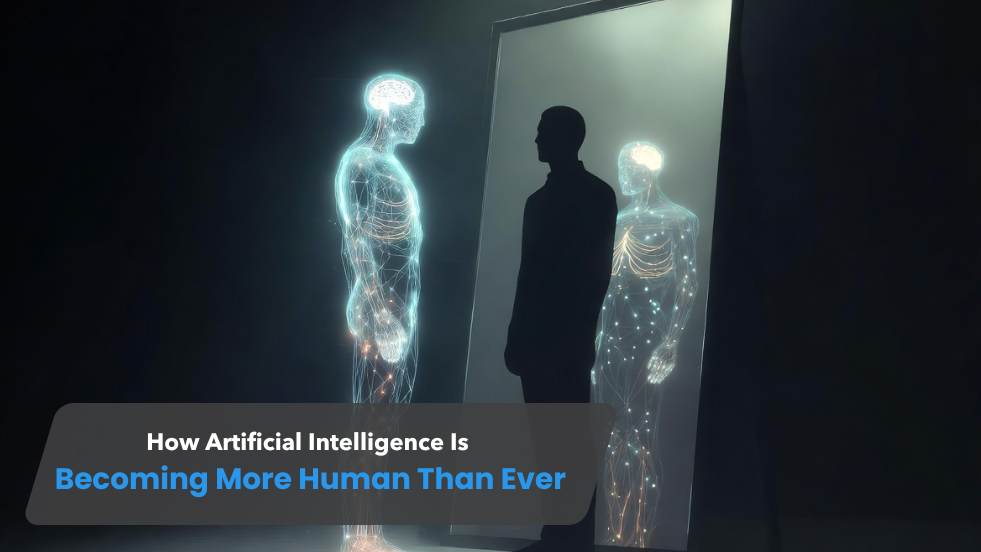
For decades, artificial intelligence (AI) was understood mainly as a tool: a system to crunch data, automate tasks, or assist humans in mundane or complex operations. Yet in recent years, a subtle but profound shift has occurred. Rather than just executing commands, modern AI systems are increasingly capable of understanding, interpreting, and responding to human emotions. This evolution hints at a future where AI isn’t just a tool, but a social entity one that can converse, empathize, and perhaps even provide emotional support. Among these emergent technologies are what we might call AI Companion App software designed not simply to answer factual questions, but to engage users in emotionally aware, human-like conversation.
Recent scientific findings suggest we may already be living in that future. Though AI lacks consciousness or genuine feelings, its capacity to simulate emotionally intelligent behavior is growing ever stronger.
What “More Human” Means Language, Empathy, Emotional Intelligence
Language & Conversation: Natural, Nuanced, Context-Aware
Large language models (LLMs) the backbone of many modern AI systems have become startlingly proficient at producing human-like language: thoughtful, contextually aware, and adaptable to tone and nuance. This alone helps them mimic conversational flow in a way earlier AI could not. When paired with emotional-intelligence capacities, they start to resemble conversational partners more than mere information-retrieval machines.
Emotional Intelligence Tests AI Is Already Competing with Humans
In a landmark 2025 study by researchers at University of Geneva (UNIGE) and University of Bern (UniBE), six generative AI systems including popular LLM-based models were subjected to five standardized emotional-intelligence (EI) tests. The results? The AIs averaged around 81% correct responses, compared to 56% for human participants.
Moreover, the same study demonstrated that one of these models could generate entirely new EI test items. These AI-authored tests, when administered to nearly 500 human participants, proved psychometrically comparable in difficulty and realism to the original tests designed by professional psychologists.
These findings challenge the long-standing assumption that emotional intelligence is an exclusively human domain. They suggest modern AI doesn’t just parse language, but can reason about emotional and social dynamics with surprising accuracy.
Cognitive Empathy: Understanding Emotions Without Feeling Them
Beyond formal tests, researchers have also begun exploring empathy in LLMs. A recent 2025 preprint study titled Heartificial Intelligence: Exploring Empathy in Language Models assessed both cognitive empathy (the ability to understand others’ emotions and perspectives) and affective empathy (the capacity to emotionally resonate) across several language models. The study found that while LLMs consistently outperformed humans in tasks requiring cognitive empathy, they lagged behind humans when it came to affective empathy.
In other words: current AI may simulate understanding of emotional states, but there is no evidence that it “feels” these emotions internally. Which, for many applications including mental-health support, companionship, or coaching may be both an advantage (consistent, unbiased responses) and a limitation (lack of genuine feeling).
Real-World Use: AI as Digital Friends and Emotional Support
As these technological capabilities advance, more developers and companies are applying them to create digital companion systems, supportive chatbots, or AI-based conversational agents including what would be classed broadly as “AI Companion Apps.” These platforms aim to offer not only information or automation but social connection: conversation, support, listening often with 24/7 availability.
Because modern LLMs can reason about emotions and respond with empathy-like behavior, users increasingly treat these apps not just as assistants, but as conversational partners or confidants. For people experiencing loneliness, stress, or social anxiety, an emotionally responsive AI companion can feel like a safe outlet.
Beyond companionship, such systems are being considered (or already used) for coaching, conflict-management, mental health check-ins, or simply as a conversational alternative to human interaction.
Why This Matters Opportunities and Benefits
Accessibility & Scalability. Unlike human counselors or friends, an AI Companion App can be available any time of day, to anyone with an internet connection. This can democratize access to conversation, emotional support, or social interaction especially in locations or circumstances where human support is limited.
Consistency & Non-judgmental Interaction. AI lacks human biases, fatigue, or mood swings. For some users, especially those hesitant to reach out to real people, neutrality can make conversation easier.
A New Form of Social Companion. For those who struggle with traditional social interaction, or who feel isolated, AI companions may offer a form of gentle social contact. Combined with improving emotional-intelligence capacities, these tools could become meaningful social aids rather than mere tools.
The Other Side Ethical, Psychological, Social Risks
Risk of Anthropomorphism and Misleading Users
As AI becomes more human-like, there is a growing danger of people projecting human attributes, feelings, consciousness, morality onto machines. This phenomenon of anthropomorphism can create unrealistic expectations or emotional dependency. Some philosophers and ethicists argue that systems that mimic empathy and companionship should clearly disclose their nature as artificial.
Emotional Dependence and Social Isolation
If people begin relying on AI companions instead of human relationships, there’s a risk of reduced human-to-human interaction. Emotional dependence on machines which cannot genuinely reciprocate feelings or understanding might lead to greater isolation, loneliness, or distorted expectations about relationships.
For vulnerable individuals (e.g., those with mental health challenges), this could be especially risky. Over-relying on emotionally responsive systems for companionship could mask deeper needs for human empathy, mutuality, and real interpersonal connection.
Limits: AI Doesn’t Truly Feel Lack of Subjectivity & Genuine Emotion
No matter how proficient a language model becomes, it remains a statistical predictor of language, not a conscious being. Its “empathy” is computational mimicry, not experience. The gap between simulated emotional response and real emotion remains fundamental, and likely unbridgeable with current technology.
This boundary matters especially if AI companionship becomes widespread because users may assume deeper understanding or emotional resonance than actually exists.
Future Directions What to Watch as AI Advances
- Multimodal empathy and embodiment: Future AI companions may integrate voice, tone detection, facial-expression recognition, and memory across sessions making conversations feel more personal and continuous.
- Hybrid human–AI models: Combining AI’s consistency and scalability with human oversight (therapists, moderators) especially in sensitive domains like mental health.
- Ethical guidelines, transparency and informed use: As AI companionship becomes more common, frameworks may arise requiring clarity: that the “companion” is artificial; that its limitations are clear; and that users understand what AI can and cannot do.
- Public discourse about what “human-like AI” means: As boundaries blur, society will need to examine ethically, philosophically, socially whether and how we integrate AI “companions” into everyday life.
Conclusion
The era when AI was only a tool is fading. With advances in language, reasoning, and emotion-simulation, AI systems are becoming more human-like than ever able to converse, empathize, and respond in emotionally intelligent ways. The emergence of AI Companion Apps reflects this shift: software that seeks not only to inform, but to connect.
At the same time, we must remain aware of the boundaries. No AI has subjective consciousness. Emotional responsiveness is simulated. Companionship from machines, while helpful, is not the same as human relationship.
As we move deeper into this new era, balance matters. Embrace the potential for support, connection, accessibility but proceed with clarity, transparency, and ethical caution. If developed and used responsibly, human-like AI could enhance our lives. But if treated as a substitute for real human connection, it might risk what makes us human in the first place.